
🪔आरतीचा दिवा, तेल आणि तत्त्वज्ञान Aarti Lamp, Oil, and Symbolism (Philosophy)
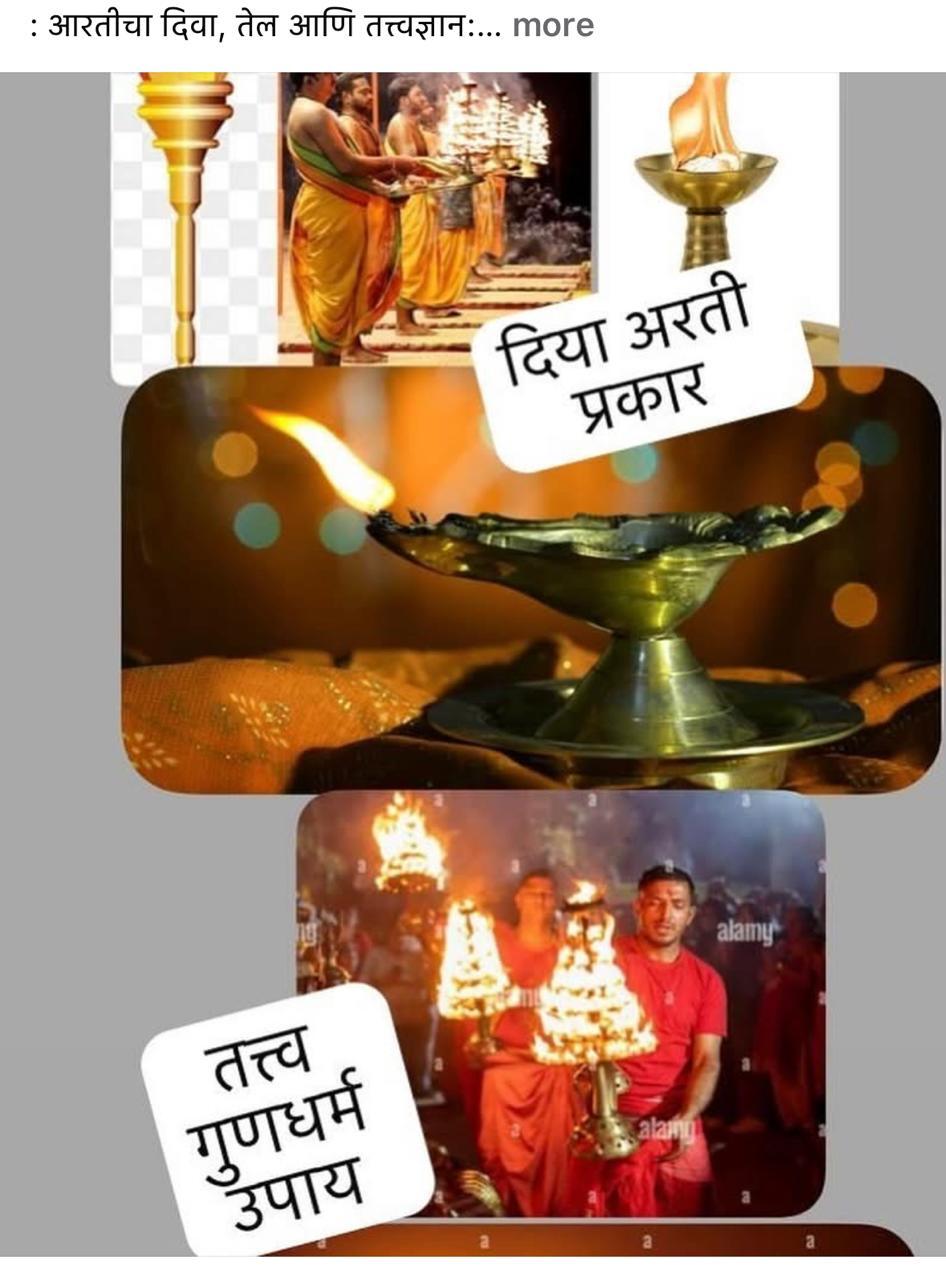
🪔 Aarti Lamp, Oil, and Symbolism (Philosophy)
🔹 Types of Lamps
There are mainly two types of lamps used in aarti:
Long-wick lamps
Cotton-wick (short wick) lamps
🔹 Importance of Oil
The purer and more sattvic (spiritually pure) the oil, the more auspicious it is considered.
Order of quality (increasing purity):
Groundnut oil → Safflower oil → Sunflower oil → Sesame oil
Sesame oil is considered the best because it is obtained through effort and labor, symbolizing devotion and dedication. It is especially recommended for use at home. Nowadays, so-called “puja oils” are often not pure (they may contain mixed oils like palm), so their quality should be checked carefully.
🔹 Importance of Wick and Ghee
The cotton wick (phool vati) should be thick and well-formed, not thin.
Using ghee or thick oil helps the flame remain steady and bright.
Among all, pure cow’s ghee is considered the most श्रेष्ठ (excellent).
🔹 The Five Elements in Aarti
Lamp (Diya) — Earth element 🌍
Wick — Air element 🌬️
Oil/Ghee — Fire element 🔥
The liquid aspect — Water element 💧
The union of all these — Space (Ether) element 🌌
Thus, through the light of the lamp, God’s divine presence is believed to manifest.
✳️ Meaning and Method of Aukshan and Aarti
🔹 What is Aukshan?
Aukshan is not a daily ritual but a ceremonial act performed to honor someone.
It is done by rotating a lamp around a person or deity to remove negative energy.
It is commonly performed on birthdays, festivals, or special occasions.
🔹 Types and Importance of Aarti
In many homes, aarti is performed daily, especially in the evening.
Friday aarti is often dedicated to Goddess Lakshmi.
Aarti of family deities (Kuldevata) is traditionally performed only at their temple, not at home.
In temples, the timing and frequency of aarti depend on the temple’s traditions.
Temples where aarti is performed more frequently are considered especially sacred (e.g., Shirdi Sai Baba, Tirupati, Swami Samarth, Dagdusheth).
🔹 Correct Way to Perform Aarti
Aarti should not be limited to one deity; it is ideal to include major deities together (Ganesha, Shiva, Vishnu, Devi, Hanuman).
After aarti, rituals like self-surrender (aatmarpan), bowing (namaskar), and clapping are also important parts.
In large temples, mantrapushpanjali is offered after aarti.
🔹 When to Perform Aarti at Home
Evening time (Deepak Aarti / Lakshmi Aarti)
Special days: Ganesh Chaturthi, Ekadashi, Navratri, etc.
In some traditions, Hanuman (Maruti) aarti is not performed daily at home
🔹 Various Types of Aarti
There are many traditional forms, such as:
Oil lamp aarti (with cotton wick)
Ghee lamp aarti (with flower wick)
Camphor aarti
Pancharti (five-wick lamp)
Ekadash aarti (11 or more wicks)
Sahasra aarti (100+ wicks, e.g., near holy rivers)
Kakad aarti (early morning, with cloth wick)
Mashaal (torch) aarti
Deep-stambh (lamp pillar) aarti with multiple lamps
Samai (traditional lamp with 1/5/7/9 wicks)
Large lamp arrangements (21, 101, 1000 lamps, etc.)
These diverse forms show the richness and depth of devotional practices in worship.
☑️